
The best way to survive an IRS audit is to prepare | tax preparation in alexandria va | Weyrich, Cronin & Sorra

The best way to survive an IRS audit is to prepare

The IRS recently released its audit statistics for the 2022 fiscal year and fewer taxpayers had their returns examined as compared with prior years. But even though a small percentage of returns are being chosen for audits these days, that will be little consolation if yours is one of them.

Recent statistics

Overall, just 0.49% of individual tax returns were audited in 2022. However, as in the past, those with higher incomes were audited at higher rates. For example, 8.5% of returns of taxpayers with adjusted gross incomes (AGIs) of $10 million or more were audited as of the end of FY 2022.

However, audits are expected to be on the rise in coming months because the Biden administration has made it a priority to go after high-income taxpayers who don’t pay what they legally owe. In any event, the IRS will examine thousands of returns this year. With proper planning, you may fare well even if you’re one of the unfortunate ones.

Be ready

The easiest way to survive an IRS examination is to prepare in advance. On a regular basis, you should systematically maintain documentation — invoices, bills, canceled checks, receipts or other proof — for all items reported on your tax returns.

Keep in mind that if you’re chosen, it’s possible you didn’t do anything wrong. Just because a return is selected for audit doesn’t mean that an error was made. Some returns are randomly selected based on statistical formulas. For example, IRS computers compare income and deductions on returns with what other taxpayers report. If an individual deducts a charitable contribution that’s significantly higher than what others with similar incomes report, the IRS may want to know why.

Returns can also be selected if they involve issues or transactions with other taxpayers who were previously selected for audit, such as business partners or investors.

The government generally has three years from when a tax return is filed to conduct an audit, and often the exam won’t begin until a year or more after you file a return.

Tax return complexity

The scope of an audit generally depends on whether it’s simple or complex. A return reflecting business or real estate income and expenses will obviously take longer to examine than a return with only salary income.

In FY 2022, most examinations (78.6%) were “correspondence audits” conducted by mail. The rest were face-to-face audits conducted at an IRS office or “field audits” at the taxpayers’ homes, businesses, or accountants’ offices.

Important: Even if you’re chosen, an IRS examination may be nothing to lose sleep over. In many cases, the IRS asks for proof of certain items and routinely “closes” the audit after the documentation is presented.

Get professional help

It’s prudent to have a tax professional represent you at an audit. A tax pro knows the issues that the IRS is likely to scrutinize and can prepare accordingly. In addition, a professional knows that in many instances IRS auditors will take a position (for example, to disallow certain deductions) even though courts and other guidance have expressed contrary opinions on the issues. Because pros can point to the proper authority, the IRS may be forced to concede on certain issues.

Contact us if you receive an IRS audit letter or simply want to improve your record keeping.

© 2023

 

That email or text from the IRS: It’s a scam! | cpa in elkton md | Weyrich, Cronin & Sorra

That email or text from the IRS: It’s a scam!

“Thousands of people have lost millions of dollars and their personal information to tax scams,” according to the IRS. The scams may come in through email, text messages, telephone calls or regular mail. Criminals regularly target both individuals and businesses and often prey on the elderly.

Important: The IRS will never contact you by email, text or social media channels about a tax bill or refund. Most IRS contacts are first made through regular mail. So if you get a text message saying it’s the IRS and asking for your Social Security number, it’s someone trying to steal your identity and rob you. Remember that the IRS already has your Social Security number.

“Scammers are coming up with new ways all the time to try to steal information from taxpayers,” said IRS Commissioner Danny Werfel. “People should be wary and avoid sharing sensitive personal data over the phone, email or social media to avoid getting caught up in these scams.”

Here are some of the crimes the IRS has identified in recent months:

Email messages and texts that infect recipients’ computers and phones. In this scam, a phony email claims to come from the IRS. The subject line of the email often states that the message is a notice of underreported income or a refund. There may be an attachment or a link to a bogus web page with your “tax statement.” When you open the attachment or click on the link, a Trojan horse virus is downloaded to your computer.

The trojan horse is an example of malicious code (also known as malware) that can take over your computer hard drive, giving someone remote access to the computer. It may also look for passwords and other information. The scammer will then use whatever information is gathered to commit identity theft, gain access to bank accounts and more.

Phishing and spear phishing messages. Emails or text messages that are designed to get users to provide personal information are called phishing. Spear phishing is a tailored phishing attempt sent to a specific organization or business department.

For example, one spear phishing scam targets employees who work in payroll departments. These employees might get an email that looks like it comes from an official source, such as the company CEO, requesting W-2 forms for all employees. The payroll employees might erroneously reply with these documents, which then provides criminals with personal information about the staff that can be used to commit fraud.

The IRS recommends using a two-person review process if you receive a request for W-2s. In addition, employers should require any requests for payroll to be submitted through an official process, like the employer’s human resources portal.

Scams keep evolving

These are only a few examples of the types of tax scams circulating. Be on guard for any suspicious messages. Don’t open attachments or click on links. Contact us if you get an email about a tax return we prepared. You can also report suspicious emails that claim to come from the IRS at phishing@irs.gov. Those who believe they may already be victims of identity theft should find out what do by going to the Federal Trade Commission’s website, OnGuardOnLine.gov.

© 2023


Starting a business? How expenses will be treated on your tax return | accounting firm in hunt valley md | Weyrich, Cronin & Sorra

Starting a business? How expenses will be treated on your tax return

Government officials saw a large increase in the number of new businesses launched during the COVID-19 pandemic. And the U.S. Census Bureau reports that business applications are still increasing slightly (up 0.4% from April 2023 to May 2023). The Bureau measures this by tracking the number of businesses applying for Employer Identification Numbers.

If you’re one of the entrepreneurs, you may not know that many of the expenses incurred by start-ups can’t be currently deducted on your tax return. You should be aware that the way you handle some of your initial expenses can make a large difference in your federal tax bill.

Handling expenses

If you’re starting or planning to launch a new business, here are three rules to keep in mind:

  1. Start-up costs include those incurred or paid while creating an active trade or business — or investigating the creation or acquisition of one.
  2. Under the tax code, taxpayers can elect to deduct up to $5,000 of business start-up and $5,000 of organizational costs in the year the business begins. As you know, $5,000 doesn’t go very far these days! And the $5,000 deduction is reduced dollar-for-dollar by the amount by which your total start-up or organizational costs exceed $50,000. Any remaining costs must be amortized over 180 months on a straight-line basis.
  3. No deductions or amortization deductions are allowed until the year when “active conduct” of your new business begins. Generally, that means the year when the business has all the pieces in place to start earning revenue. To determine if a taxpayer meets this test, the IRS and courts generally ask questions such as: Did the taxpayer undertake the activity intending to earn a profit? Was the taxpayer regularly and actively involved? Did the activity actually begin?

Rules to qualify

In general, start-up expenses are those you incur to:

  • Investigate the creation or acquisition of a business,
  • Create a business, or
  • Engage in a for-profit activity in anticipation of that activity becoming an active business.

To qualify for the election, an expense also must be one that would be deductible if it were incurred after a business began. One example is money you spend analyzing potential markets for a new product or service.

To be eligible as an “organization expense,” an expense must be related to establishing a corporation or partnership. Some examples of organization expenses are legal and accounting fees for services related to organizing a new business and filing fees paid to the state of incorporation.

Decision to be made

If you have start-up expenses that you’d like to deduct this year, you need to decide whether to take the election described above. Recordkeeping is critical. Contact us about your start-up plans. We can help with the tax and other aspects of your new business.

© 2023


Hiring family members can offer tax advantages (but be careful) | tax preparation in alexandria va | Weyrich, Cronin & Sorra

Hiring family members can offer tax advantages (but be careful)

Summertime can mean hiring time for many types of businesses. With legions of working-age kids and college students out of school, and some spouses of business owners looking for part-time or seasonal work, companies may have a much deeper hiring pool to dive into this time of year.

If you’re considering hiring your children or spouse, there could be some tax advantages in play. However, you’ll need to be careful about following the IRS rules.

Employing your kids

Children who work for the business of a parent are subject to income tax withholding regardless of age. If the company is a partnership or corporation, children’s wages are also subject to Social Security and Medicare taxes (commonly known as FICA taxes) and Federal Unemployment Tax Act (FUTA) taxes — unless each partner is a parent of the child.

However, substantial savings are possible for a business that’s a sole proprietorship or a partnership in which each partner is a parent of the child-employee. In such cases:

  • Children under age 18 aren’t subject to FICA or FUTA taxes, and
  • Children who are 18 to 20 years old are subject to FICA taxes but not FUTA taxes.

As you can see, substantial tax savings may be in the offing depending on your child’s age. Avoiding FICA or FUTA taxes, or both, means more money in your pocket and that of your child.

It’s also worth noting that children generally are taxed at lower rates than their parents. Moreover, a child’s income can be offset partially or completely by the child’s standard deduction ($13,850 for single taxpayers in 2023). If your child earns less than the standard deduction, income is tax-free for the child on top of being deductible for the business.

Hiring your spouse

When your spouse goes to work for your business, that individual’s wages are subject to income tax withholding and FICA taxes — but not FUTA taxes. Employers generally must pay 6% of an employee’s first $7,000 in earnings as the FUTA tax, subject to tax credits for state unemployment taxes paid. Thus, you’ll save the money you’d otherwise spend for a nonspouse employee’s FUTA taxes.

It’s important that your spouse is treated and compensated as an employee. When spouses run a business together, and they share in profits and losses, the IRS may deem them partners — even in the absence of a formal partnership agreement.

You also may reap some savings from hiring your spouse if you’re a sole proprietor and have a Health Reimbursement Arrangement (HRA). Your family can receive tax-free reimbursement from the business for medical expenses, and the business can deduct the reimbursements — reducing your income and self-employment taxes. HRA reimbursements aren’t subject to FICA taxes and the plan itself is a tax-free fringe benefit for your spouse. Do note, however, that this strategy isn’t available if you have other employees.

Handling it properly

Whether you decide to hire a child or spouse, or both, you’ll need to step carefully. Assign them actual job duties, pay them a reasonable amount, and keep thorough employment records (including timesheets as well as IRS Forms W-4 and I-9). Essentially, treat them as you would any other employee. Our firm can help you handle the situation properly.

© 2023


Solo business owner? There’s a 401(k) for that | business consulting firms in dc | Weyrich, Cronin & Sorra

Solo business owner? There’s a 401(k) for that

If you own a successful small business with no employees, you might be ready to set up a retirement plan. Now a 401(k) might seem way out of your reach — only bigger companies can manage one of those, right? Not necessarily.

Two ways to contribute

With a solo 401(k), the self-employed can make large annual deductible contributions to a qualified (that is, tax-advantaged) retirement account. However, this prime nest-egg-building opportunity comes with some administrative complexity.

How much can you contribute? For the 2023 tax year, you can make an “elective deferral contribution” of up to $22,500 of your net self-employment (SE) income to a solo 401(k). If you’ll be 50 or older as of December 31, 2023, you can make additional catch-up contributions up to $7,500 for a grand total of $30,000.

On top of your elective deferral contribution, an additional contribution of up to 25% (depending on your business structure) of net SE income is also permitted. This additional pay-in is called an “employer contribution,” though of course there’s no employer other than you when you’re self-employed.

For purposes of calculating the employer contribution, your net SE income isn’t reduced by your elective deferral contribution. So, for the 2023 tax year, the combined elective deferral and employer contributions can’t exceed:

  • $66,000 ($73,500 with the max catch-up contribution if you qualify), or
  • 100% of your net SE income.

Along with the ability to make such a large annual deductible contribution, another advantage of solo 401(k)s is that contributions are completely discretionary. When cash is tight, you can contribute a small amount or nothing. In years when cash flow is strong, you can contribute the maximum allowable amount.

In addition, you can borrow from your solo 401(k) account, assuming the plan document permits it — which you should insist on when working with a provider (usually a financial services firm). The maximum loan amount is 50% of the account balance or $50,000, whichever is less. Some other types of retirement plans don’t allow loans.

Downsides to consider

The biggest downside to a solo 401(k) is, as mentioned, administrative complexity. You’ll encounter some substantial upfront paperwork when applying for a plan with a provider.

From there, ongoing administrative efforts will be required, including adopting a written plan document and arranging for how and when elective deferral contributions will be collected and paid into the account. Also, once your solo 401(k) account balance exceeds $250,000, you must file Form 5500-EZ with the IRS each year.

Bottom line

For a one-person business, a solo 401(k) may be a smart, tax-favored retirement plan choice as long as you have the desire and cash flow to make large contributions. This is particularly true if you’re 50 or older. Of course, there are other options to consider. We can help you shop for the right retirement plan, set one up and administer it going forward.

© 2023


If your family owns a vacation home, address it carefully in your estate plan | estate planning cpa in baltimore county md | Weyrich, Cronin & Sorra

If your family owns a vacation home, address it carefully in your estate plan

For many people, the disposition of a family home is an emotionally charged estate planning issue. And emotions may run even higher with vacation homes, which often evoke even fonder memories. So, it’s important to address your vacation home carefully in your estate plan.

Keeping the peace

Before you do anything, talk with your loved ones about the vacation home. Simply dividing the home equally among your children or other family members may be an invitation to conflict and hurt feelings. Some may care more about keeping the home in the family than about any financial benefits it might provide. Others may prefer to sell the home and use the proceeds for other needs.

One solution is to leave the vacation home to the family members who want it and leave other assets to those who don’t. Alternatively, you can develop a buyout plan that establishes the terms under which family members who want to keep the home can buy the interests of those who want to sell. The plan should establish a reasonable price and payment terms, which might include payment in installments over several years.

You also may want to create a usage schedule for nonowners whom you wish to continue enjoying the vacation home. And to help alleviate the costs of keeping the vacation home in the family, consider setting aside assets that will generate income to pay for maintenance, repairs, property taxes and other expenses.

Transferring the home

After determining who will receive your vacation home, there are several traditional estate planning tools you can use to transfer it in a tax-efficient manner. It may make sense to transfer interests in the home to your children or other family members now, using tax-free gifts.

But if you’re not yet ready to give up ownership, consider a qualified personal residence trust (QPRT). With a QPRT, you transfer a qualifying vacation home to an irrevocable trust, retaining the right to occupy the home during the trust term. At the end of the term, the home is transferred to your beneficiaries, though it’s possible to continue occupying the home by paying them fair market rent. The transfer is a taxable gift of your beneficiaries’ remainder interest, which is only a fraction of the home’s current fair market value.

You must survive the trust term, and the vacation home must qualify as a “personal residence,” which means, among other things, that you use it for the greater of 14 days per year or more than 10% of the total number of days it’s rented out.

Discussing your intentions

These are only a few of the issues that may be involved in passing on a vacation home. Estate planning for a vacation home may be complicated but it doesn’t have to be. The key is to sit down with your family to discuss the options. Only then can you put together a plan that meets everyone’s needs. Contact us with questions about the most tax-efficient way to proceed.

© 2023


Reduce the impact of the 3.8% net investment income tax | tax accountants in cecil county | Weyrich, Cronin & Sorra

Reduce the impact of the 3.8% net investment income tax

High-income taxpayers face a regular income tax rate of 35% or 37%. And they may also have to pay a 3.8% net investment income tax (NIIT) that’s imposed in addition to regular income tax. Fortunately, there are some ways you may be able to reduce its impact.

Affected taxpayers

The NIIT applies to you only if modified adjusted gross income (MAGI) exceeds:

  • $250,000 for married taxpayers filing jointly and surviving spouses,
  • $125,000 for married taxpayers filing separately,
  • $200,000 for unmarried taxpayers and heads of household.

The amount subject to the tax is the lesser of your net investment income or the amount by which your MAGI exceeds the threshold ($250,000, $200,000, or $125,000) that applies to you.

Net investment income includes interest, dividend, annuity, royalty and rental income, unless those items were derived in the ordinary course of an active trade or business. In addition, other gross income from a trade or business that’s a passive activity is subject to the NIIT, as is income from a business trading in financial instruments or commodities.

There are many types of income that are exempt from the NIIT. For example, tax-exempt interest and the excluded gain from the sale of your main home aren’t subject to the tax. Distributions from qualified retirement plans aren’t subject to the NIIT. Neither are Social Security benefits. Wages and self-employment income also aren’t subject to the NIIT, though they may be subject to a different Medicare surtax.

It’s important to remember the NIIT applies only if you have net investment income and your MAGI exceeds the applicable thresholds above. But by following strategies, you may be able to minimize your net investment income.

Shifting investments

If your income is high enough to trigger the NIIT, shifting some income investments to tax-exempt bonds could result in less exposure to the tax. Tax-exempt bonds lower your MAGI and avoid the NIIT.

Dividend-paying stocks are taxed more heavily as a result of the NIIT. The maximum income tax rate on qualified dividends is 20%, but the rate becomes 23.8% with the NIIT.

As a result, you may want to consider rebalancing your investment portfolio to emphasize growth stocks over dividend-paying stocks. While the capital gains from these investments will be included in net investment income, there are two potential benefits: 1) the tax will be deferred because the capital gains won’t be subject to the NIIT until the stocks are sold, and 2) capital gains can be offset by capital losses, which isn’t the case with dividends.

Retirement plan distributions

Because distributions from qualified retirement plans are exempt from the NIIT, upper-income taxpayers with some control over their situations (such as small business owners) might want to make greater use of qualified plans.

These are only a couple of strategies you may be able to employ. You also may be able to make moves related to charitable donations, passive activities and rental income that may allow you to minimize the NIIT. If you’re subject to the tax, you should include it in your tax planning. Contact us for strategies in your situation.

© 2023


Advantages and disadvantages of claiming big first-year real estate depreciation deductions | business consulting and accounting services in elkton | Weyrich, Cronin & Sorra

Advantages and disadvantages of claiming big first-year real estate depreciation deductions

Your business may be able to claim big first-year depreciation tax deductions for eligible real estate expenditures rather than depreciate them over several years. But should you? It’s not as simple as it may seem.

Qualified improvement property

For qualifying assets placed in service in tax years beginning in 2023, the maximum allowable first-year Section 179 depreciation deduction is $1.16 million. Importantly, the Sec. 179 deduction can be claimed for real estate qualified improvement property (QIP), up to the maximum annual allowance.

QIP includes any improvement to an interior portion of a nonresidential building that’s placed in service after the date the building is placed in service. For Sec. 179 deduction purposes, QIP also includes HVAC systems, nonresidential building roofs, fire protection and alarm systems and security systems that are placed in service after the building is first placed in service.

However, expenditures attributable to the enlargement of the building, any elevator or escalator, or the building’s internal structural framework don’t count as QIP and must be depreciated over several years.

Mind the limitations

A taxpayer’s Sec. 179 deduction can’t cause an overall business tax loss, and the maximum deduction is phased out if too much qualifying property is placed in service in the tax year. The Sec. 179 deduction limitation rules can get tricky if you own an interest in a pass-through business entity (partnership, LLC treated as a partnership for tax purposes, or S corporation). Finally, trusts and estates can’t claim Sec. 179 deductions, and noncorporate lessors face additional restrictions. We can give you full details.

First-year bonus depreciation for QIP

Beyond the Sec. 179 deduction, 80% first-year bonus depreciation is also available for QIP that’s placed in service in calendar year 2023. If your objective is to maximize first-year write-offs, you’d claim the Sec. 179 deduction first. If you max out on that, then you’d claim 80% first-year bonus depreciation.

Note that for first-year bonus depreciation purposes, QIP doesn’t include nonresidential building roofs, HVAC systems, fire protection and alarm systems, or security systems.

Consider depreciating QIP over time

Here are two reasons why you should think twice before claiming big first-year depreciation deductions for QIP.

1. Lower-taxed gain when property is sold

First-year Sec. 179 deductions and bonus depreciation claimed for QIP can create depreciation recapture that’s taxed at higher ordinary income rates when the QIP is sold. Under current rules, the maximum individual rate on ordinary income is 37%, but you may also owe the 3.8% net investment income tax (NIIT).

On the other hand, for QIP held for more than one year, gain attributable to straight-line depreciation is taxed at an individual federal rate of only 25%, plus the 3.8% NIIT if applicable.

2. Write-offs may be worth more in the future

When you claim big first-year depreciation deductions for QIP, your depreciation deductions for future years are reduced accordingly. If federal income tax rates go up in future years, you’ll have effectively traded potentially more valuable future-year depreciation write-offs for less-valuable first-year write-offs.

As you can see, the decision to claim first-year depreciation deductions for QIP, or not claim them, can be complicated. Consult with us before making depreciation choices.

© 2023

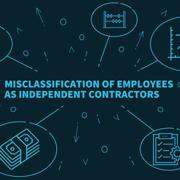
If you’re hiring independent contractors, make sure they’re properly handled | quickbooks consultant in baltimore md | Weyrich, Cronin & Sorra

If you’re hiring independent contractors, make sure they’re properly handled

Many businesses use independent contractors to help keep their costs down — especially in these times of staff shortages and inflationary pressures. If you’re among them, be careful that these workers are properly classified for federal tax purposes. If the IRS reclassifies them as employees, it can be an expensive mistake.

The question of whether a worker is an independent contractor or an employee for federal income and employment tax purposes is a complex one. If a worker is an employee, your company must withhold federal income and payroll taxes and pay the employer’s share of FICA taxes on the wages, plus FUTA tax. A business may also provide the worker with fringe benefits if it makes them available to other employees. In addition, there may be state tax obligations.

On the other hand, if a worker is an independent contractor, these obligations don’t apply. In that case, the business simply sends the contractor a Form 1099-NEC for the year showing the amount paid (if it’s $600 or more).

No one definition

Who’s an “employee?” Unfortunately, there’s no uniform definition of the term.

The IRS and courts have generally ruled that individuals are employees if the organization they work for has the right to control and direct them in the jobs they’re performing. Otherwise, the individuals are generally independent contractors. But other factors are also taken into account including who provides tools and who pays expenses.

Some employers that have misclassified workers as independent contractors may get some relief from employment tax liabilities under Section 530. This protection generally applies only if an employer meets certain requirements. For example, the employer must file all federal returns consistent with its treatment of a worker as a contractor and it must treat all similarly situated workers as contractors.

Note: Section 530 doesn’t apply to certain types of workers.

You can ask the IRS but think twice

Be aware that you can ask the IRS (on Form SS-8) to rule on whether a worker is an independent contractor or employee. However, you should also be aware that the IRS has a history of classifying workers as employees rather than independent contractors.

Businesses should consult with us before filing Form SS-8 because it may alert the IRS that your business has worker classification issues — and it may unintentionally trigger an employment tax audit.

It may be better to properly set up a relationship with workers to treat them as independent contractors so that your business complies with the tax rules.

Workers who want an official determination of their status can also file Form SS-8. Dissatisfied independent contractors may do so because they feel entitled to employee benefits and want to eliminate their self-employment tax liabilities.

If a worker files Form SS-8, the IRS will notify the business with a letter. It identifies the worker and includes a blank Form SS-8. The business is asked to complete and return the form to the IRS, which will render a classification decision.

These are the basic tax rules. Contact us if you’d like to discuss how to classify workers at your business. We can help make sure that your workers are properly classified.

© 2023

Use the tax code to make business losses less painful | cpa in cecil county md | Weyrich, Cronin & Sorra

Use the tax code to make business losses less painful

Whether you’re operating a new company or an established business, losses can happen. The federal tax code may help soften the blow by allowing businesses to apply losses to offset taxable income in future years, subject to certain limitations.

Qualifying for a deduction

The net operating loss (NOL) deduction addresses the tax inequities that can exist between businesses with stable income and those with fluctuating income. It essentially lets the latter average out their income and losses over the years and pay tax accordingly.

You may be eligible for the NOL deduction if your deductions for the tax year are greater than your income. The loss generally must be caused by deductions related to your:

  • Business (Schedules C and F losses, or Schedule K-1 losses from partnerships or S corporations),
  • Casualty and theft losses from a federally declared disaster, or
  • Rental property (Schedule E).

The following generally aren’t allowed when determining your NOL:

  • Capital losses that exceed capital gains,
  • The exclusion for gains from the sale or exchange of qualified small business stock,
  • Nonbusiness deductions that exceed nonbusiness income,
  • The NOL deduction itself, and
  • The Section 199A qualified business income deduction.

Individuals and C corporations are eligible to claim the NOL deduction. Partnerships and S corporations generally aren’t eligible, but partners and shareholders can use their separate shares of the business’s income and deductions to calculate individual NOLs.

Limitations

The Tax Cuts and Jobs Act (TCJA) made significant changes to the NOL rules. Previously, taxpayers could carry back NOLs for two years, and carry forward the losses 20 years. They also could apply NOLs against 100% of their taxable income.

The TCJA limits the NOL deduction to 80% of taxable income for the year and eliminates the carryback of NOLs (except for certain farming losses). However, it does allow NOLs to be carried forward indefinitely.

A COVID-19 relief law temporarily loosened the TCJA restrictions. It allowed NOLs arising in 2018, 2019 or 2020 to be carried back five years and removed the taxable income limitation for years beginning before 2021. As a result, NOLs could completely offset income. However, these provisions have expired.

If your NOL carryforward is more than your taxable income for the year to which you carry it, you may have an NOL carryover. The carryover will be the excess of the NOL deduction over your modified taxable income for the carryforward year. If your NOL deduction includes multiple NOLs, you must apply them against your modified taxable income in the same order you incurred them, beginning with the earliest.

Excess business losses

The TCJA established an “excess business loss” limitation, which took effect in 2021. For partnerships or S corporations, this limitation is applied at the partner or shareholder level, after the outside basis, at-risk and passive activity loss limitations have been applied.

Under the rule, noncorporate taxpayers’ business losses can offset only business-related income or gain, plus an inflation-adjusted threshold. For 2023, that threshold is $289,000 ($578,000 if married filing jointly). Remaining losses are treated as an NOL carryforward to the next tax year. In other words, you can’t fully deduct them because they become subject to the 80% income limitation on NOLs, reducing their tax value.

Important: Under the Inflation Reduction Act, the excess business loss limitation applies to tax years beginning before January 1, 2029. Under the TCJA, it had been scheduled to expire after December 31, 2026.

Planning ahead

The tax rules regarding business losses are complex, especially when accounting for how NOLs can interact with other potential tax breaks. We can help you chart the best course forward.

© 2023